Why glucose sensors need a diffusion-limiting membrane
Implanted or wearable biosensors often require diffusion-limiting membrane coatings to precisely control the transport of target analytes. To address this need, Medical Surface has developed the MediShield™ Diffusion-Limiting Membrane Coatings for biosensors, designed to regulate analyte diffusion and permeation.
Electrochemical glucose sensors — particularly continuous glucose monitors (CGMs) — rely on glucose oxidase (GOx), which consumes both glucose and oxygen. In physiological fluids, the molar concentration of glucose (5–15 mM) vastly exceeds dissolved oxygen (~0.1 mM) — creating substrate excess that saturates the enzyme and compresses the sensor's linear detection range.
MediShield™ GLM Coating selectively restricts glucose permeation across the membrane while maintaining near-maximal oxygen transport to the sensing layer. This restores stoichiometric balance — extending the linear detection range to cover the full clinical glucose range (0–30 mM).
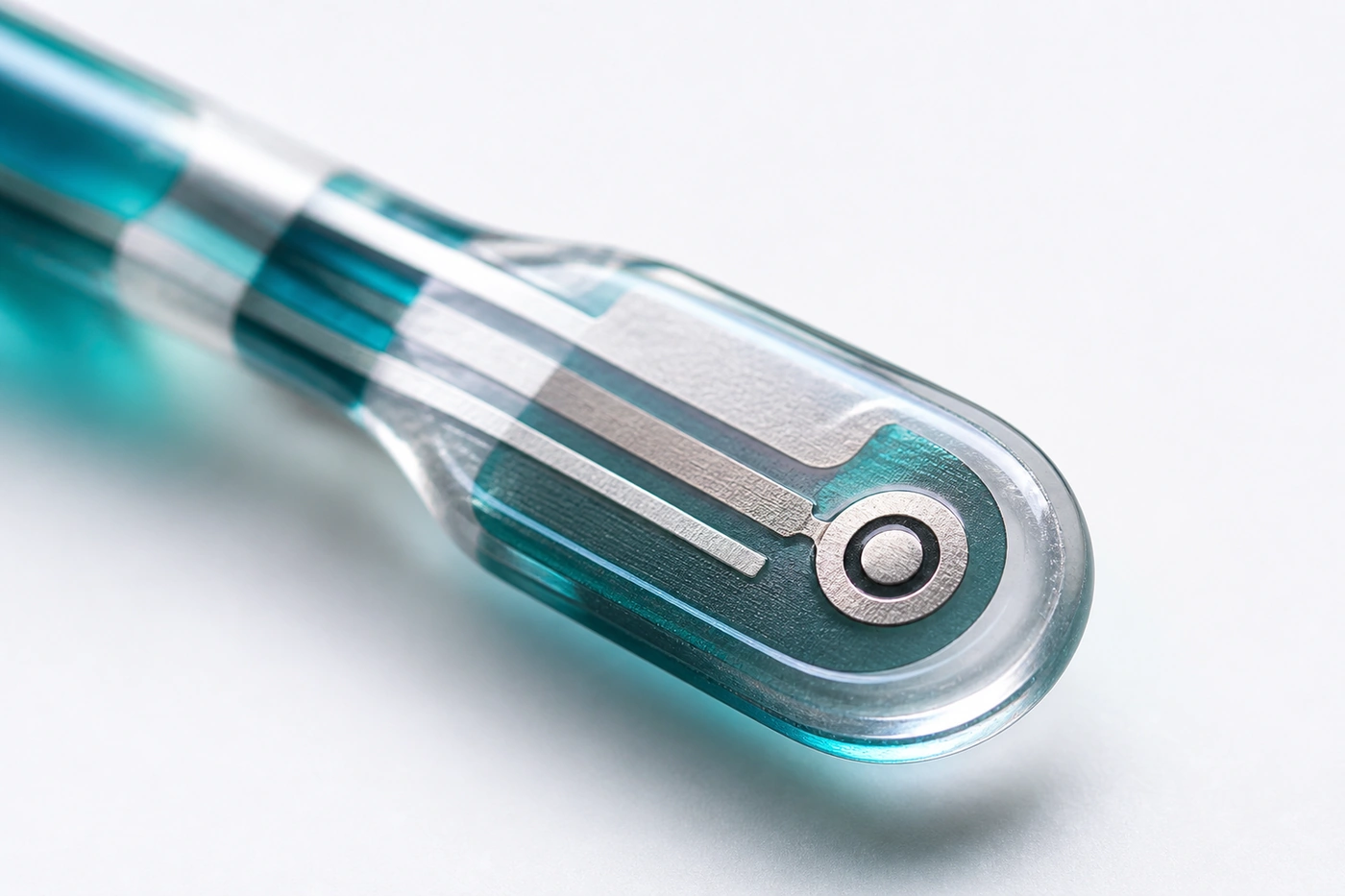
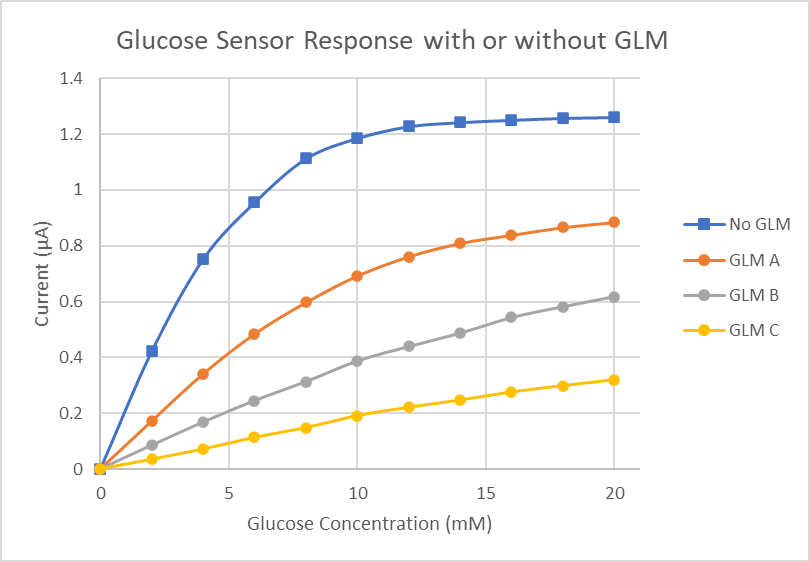
MediShield™ GLM Coating performance — glucose sensor linearity vs. GLM grade. GLM B is more restrictive than GLM A; GLM C is more restrictive than GLM B. As restriction increases, linearity range extends toward the full clinical glucose range (0–30 mM).
How the GLM grades compare
An uncoated glucose sensor exhibits a limited linearity range due to the high glucose-to-oxygen ratio in the physiological environment. Our GLM coatings selectively restrict glucose diffusion while allowing maximal oxygen transport to the sensing layer.
The degree of glucose restriction can be precisely controlled through our coating process. As the GLM coating becomes increasingly restrictive to glucose permeation — where GLM B is more restrictive than GLM A, and GLM C is more restrictive than GLM B — the linearity of glucose detection correspondingly improves.
| Grade | Restriction | Linearity |
|---|---|---|
| Uncoated | None | ~0–10 mM |
| GLM A | Mild | Extended |
| GLM B | Moderate | Further extended |
| GLM C | High | 0–30 mM (full clinical range) |